Primary Intel Node
Coordination services, browser/build/test work, fallback execution, MCP access, Open WebUI integration and daily operational services.
Local + Cloud
InnerChispa is built to reduce dependency on external credits without becoming isolated from the best models. Local AMD and Intel nodes, RalphiIA MCP, Mongo coordination, Open WebUI, Cloudflare, Google Cloud, Alibaba Cloud and external model APIs each have a clear role.
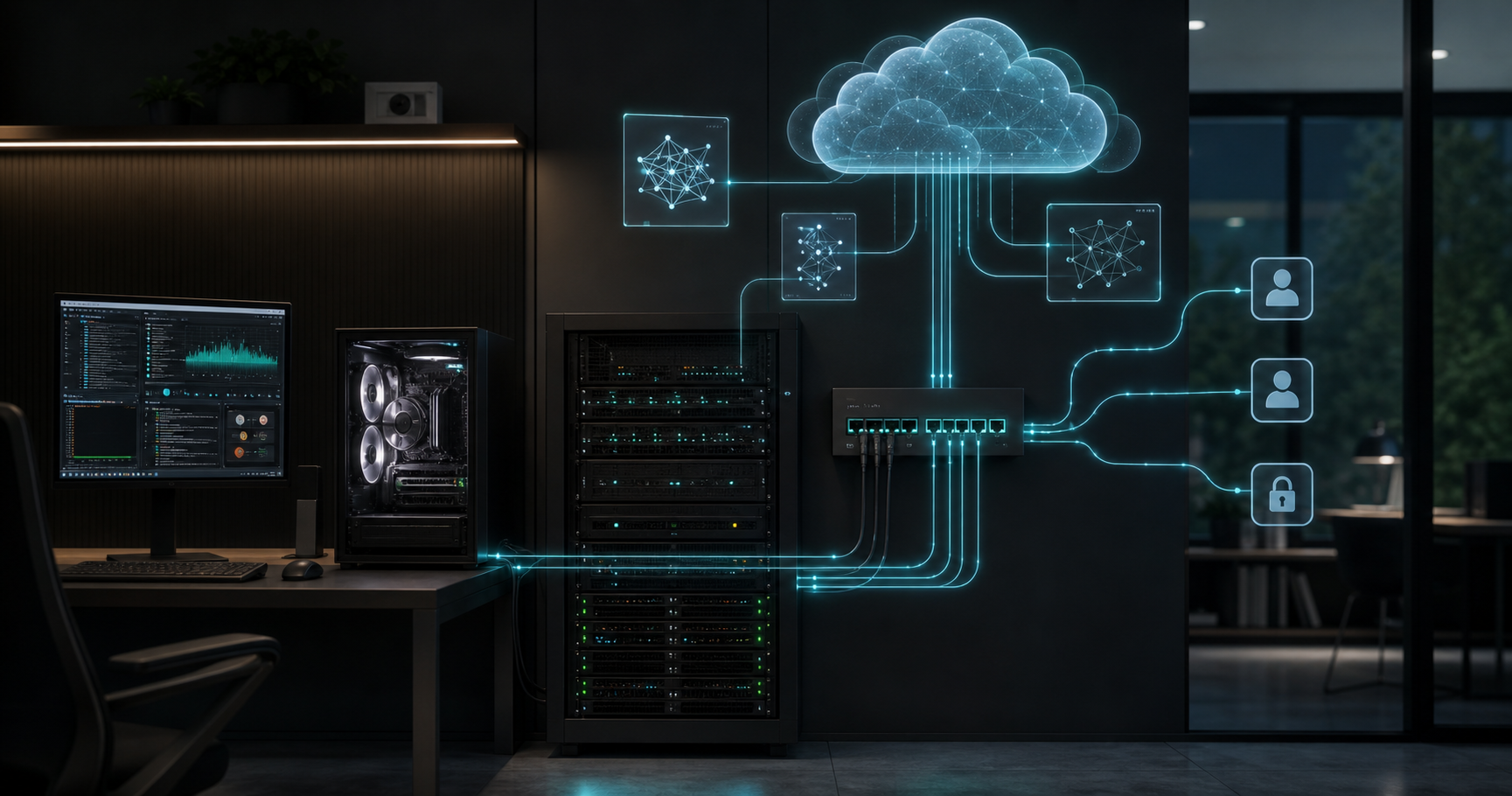
Server Fabric
The public site describes roles without exposing private IPs or credentials.
Coordination services, browser/build/test work, fallback execution, MCP access, Open WebUI integration and daily operational services.
Local-first AI capacity for coding, heavy reasoning and private model experiments, with vLLM/ROCm direction and rollback-aware model registry.
Shared bridge for ChatGPT, Codex, Cursor, Open WebUI and agents. It exposes tools, state, runbooks, documents and operational actions under governance.
Cloud Run, Cloudflare, Google Cloud, Alibaba Cloud and external model providers extend reach when public access, scale or advanced models are needed.
The primary local environment carries coordination services, browser/build/test work, operational APIs, MCP access, Open WebUI integration and day-to-day services.
The AMD node is the strategic local AI brain for heavier coding and reasoning workloads, local model experiments, private inference and future vLLM/ROCm routing.
RalphiIA MCP is the bridge: it lets ChatGPT, Codex, Cursor, Open WebUI and agents share tools, state, runbooks and operational actions.
Local-first execution avoids spending cloud credits on every coding, reasoning, summarization or automation task. The system should know when local is enough.
When a task needs stronger models, public hosting, serverless scale, crawler data, or provider-specific tools, the system can escalate to OpenAI, Gemini, Claude, Qwen providers, Google Cloud, Cloudflare, Alibaba Cloud, Bright Data or other services.
Model routing should expose selected node, selected model, backend, reason, health and fallback status so operators can see where work actually ran.
Architecture Diagram
Operators ask, approve and supervise.
Persistent operational intelligence.
Memory, agents, models, tools, tasks, guards and devices.
Local-first when control matters; cloud when capability matters.
Quotes, workforce, field service, security, documents and evidence.